15-Year vs. 30-Year Fixed Mortgage: The Mathematical Comparison
> Quick Answer: Choosing a 15-year fixed mortgage over a 30-year fixed mortgage requires a 35% to 45% higher monthly payment, but reduces total lifetime interest by 55% to 65%. On a $400,000 home loan, a 15-year mortgage at 5.75% requires a monthly payment of $3,321 (923 more per month than a 30-year at 6.50%), but saves **312,300 in total interest** and builds 100% home equity in half the time.
> Executive Summary: This corporate and consumer mortgage analysis models the financial trade-offs between 15-year and 30-year amortizing debt. We break down principal paydown velocity year by year, calculate opportunity costs of deploying extra cash flow into equity index funds (S&P 500), and define decision criteria for homeowners. Run your numbers live using our Mortgage & Amortization Calculator.
1. Head-to-Head Financial Comparison ($400,000 Principal)
Lenders price 15-year mortgages at lower interest rates because the shorter maturity horizon reduces duration risk for the lending institution:
| Parameter | 30-Year Fixed Loan | 15-Year Fixed Loan | Difference / Impact |
|---|---|---|---|
| Benchmark Interest Rate | 6.50% | 5.75% | -0.75% (75 bps rate discount) |
| Monthly Payment (P&I) | $2,528.27 | $3,321.46 | +$793.19 / month (+31.4%) |
| Total Number of Payments | 360 payments | 180 payments | 180 fewer monthly checks |
| Total Interest Paid | $510,178 | $197,863 | $312,315 Saved (61.2% Reduction) |
| Total Loan Cost | $910,178 | $597,863 | $312,315 Total Cash Saved |
| Principal Repaid in Year 5 | $27,854 (7.0%) | $96,512 (24.1%) | 3.5x Faster Equity Velocity |
2. Amortization Velocity: Why the Math Favors 15-Year Loans
On a 30-year loan, the early years of repayment are heavily weighted toward interest charges. During Year 1 of a $400,000 30-year mortgage at 6.50%:
- Total Year 1 Payments: $30,339
- Interest Component: $25,836 (85.2% of your money goes to the bank)
- Principal Component: $4,503 (Only 14.8% builds net worth)
In contrast, during Year 1 of a 15-year mortgage at 5.75%:
- Total Year 1 Payments: $39,858
- Interest Component: $22,668 (56.9% goes to interest)
- Principal Component: $17,190 (43.1% directly builds equity)
By Year 5, the 15-year borrower has built nearly $100,000 in equity through scheduled payments alone, insulating the household against property market corrections.
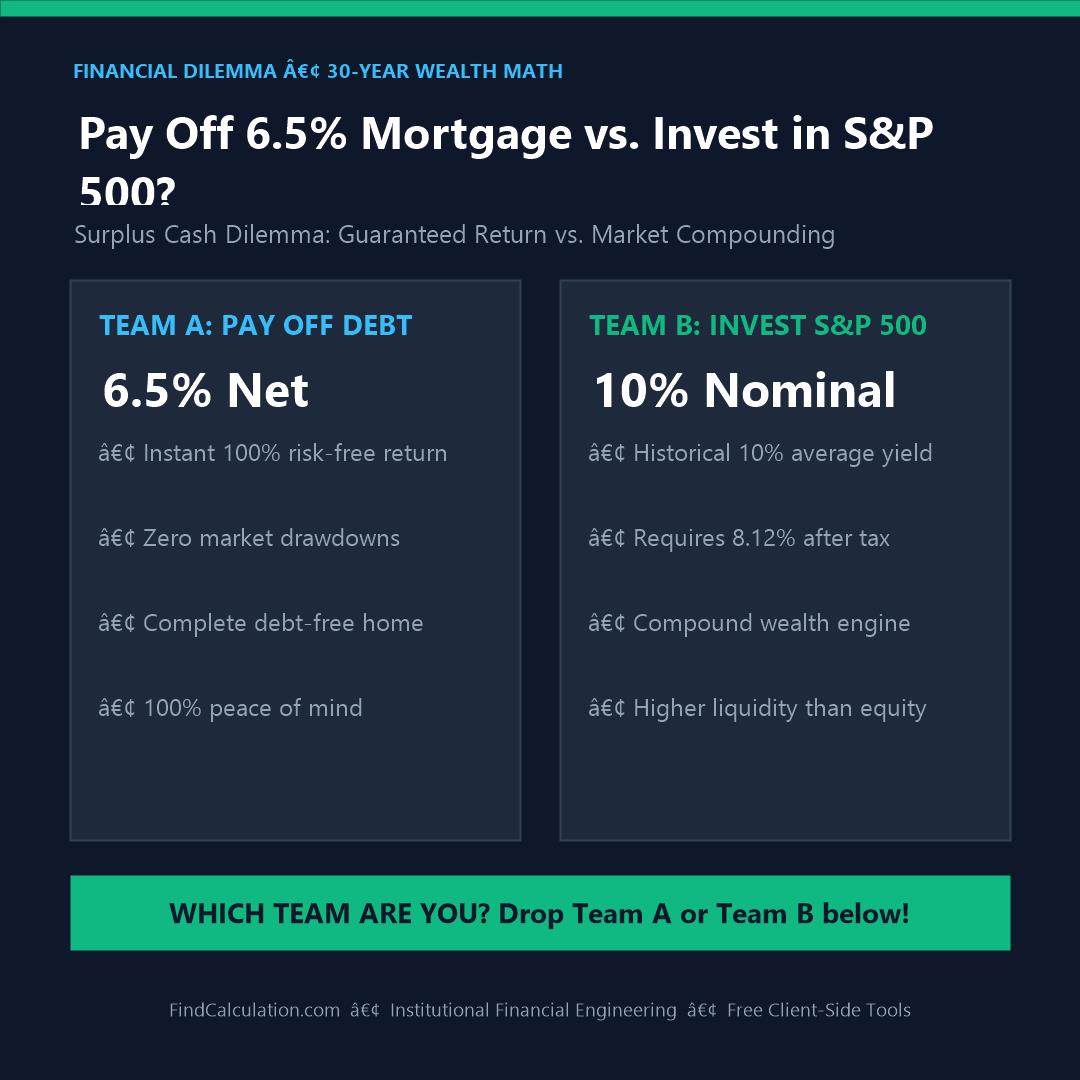
3. The Opportunity Cost Consideration: Investing vs Debt Reduction
While the interest savings on a 15-year mortgage are guaranteed and risk-free, prospective buyers must evaluate the opportunity cost of the required monthly cash flow delta (793/month on a400k loan):
- If a household commits to a 30-year mortgage and invests the $793/month delta into a low-cost S&P 500 index fund generating a net 8.0% annualized return:
- Over 15 years, that investment account compounds to approximately $275,000.
- Over 30 years, that compounding wealth engine reaches over $1,180,000.
Strategic Rule: If your investment return after taxes comfortably exceeds your mortgage interest rate, the 30-year mortgage paired with disciplined index investing can produce higher total net worth. However, if market risk tolerance is low or guaranteed peace of mind is valued, the 15-year mortgage provides unmatched certainty.
4. Decision Matrix: Which Loan Suits Your Profile?
Choose a 15-Year Mortgage If:
- 1Your debt-to-income (DTI) ratio remains under 28% with the higher payment.
- 2You are within 15 years of targeted retirement and want housing costs eliminated.
- 3You prioritize guaranteed, risk-free savings over stock market volatility.
Choose a 30-Year Mortgage If:
- 1You value monthly cash flow flexibility during volatile economic periods.
- 2You plan to invest extra cash flow into business growth or broad-market equity index funds.
- 3You want the option to prepay principal voluntarily without mandatory contractual obligations.
5. Frequently Asked Questions
Can I turn a 30-year mortgage into a 15-year mortgage voluntarily?
Yes. By making additional principal curtailment payments each month equivalent to the 15-year payment amount, you can retire a 30-year mortgage in approximately 15 to 16 years without contractual commitment.
Are closing costs higher on a 15-year loan?
Closing costs are virtually identical between 15-year and 30-year loans, as origination fees, appraisal fees, title insurance, and escrow reserves are based on loan size rather than tenure.
Educational Disclaimer: Sourced from standard mortgage banking equations. Consult a licensed mortgage broker and financial planner before selecting loan terms.