SBP Policy Rate Cuts: How Lower KIBOR Impacts Car Financing and Home Loans
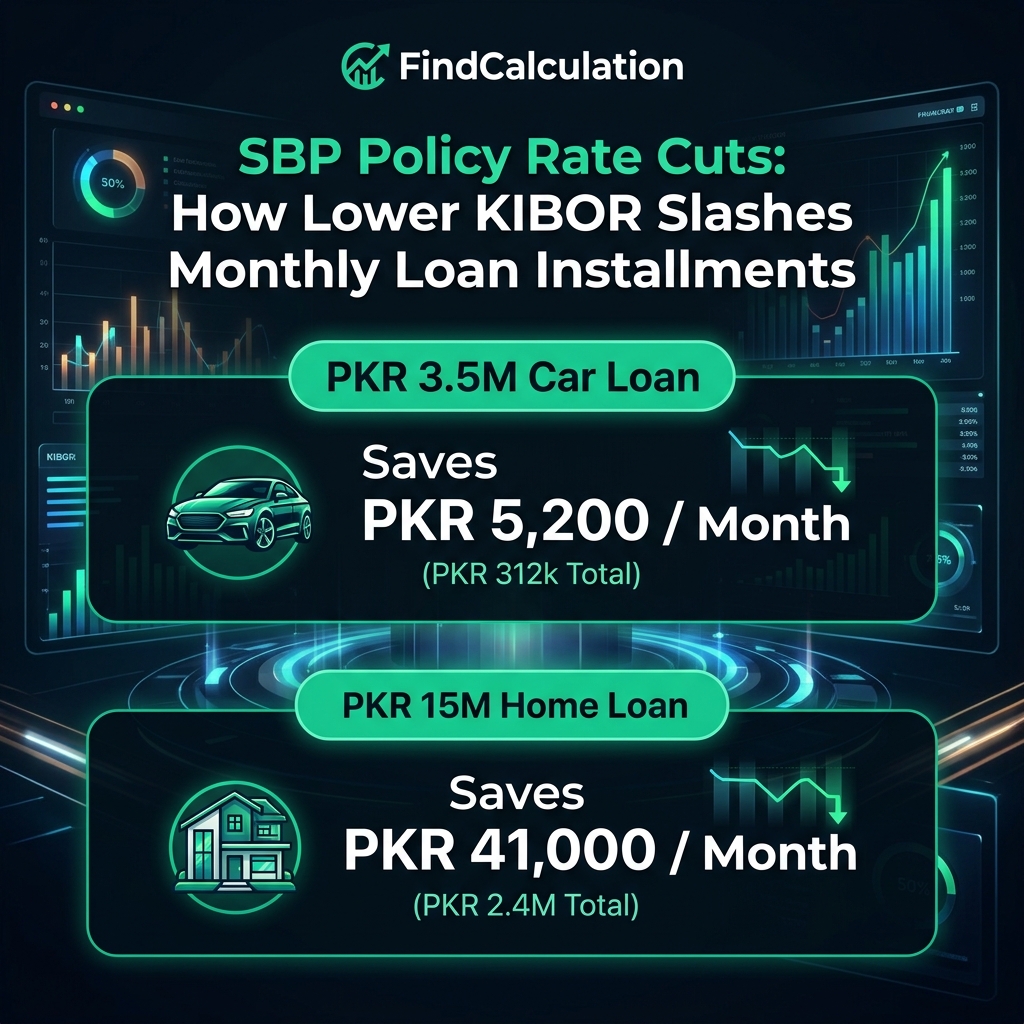
> Quick Answer: When the State Bank of Pakistan (SBP) cuts its benchmark Policy Rate (Target Rate), the Karachi Interbank Offered Rate (KIBOR) drops across all tenors (1-Month, 3-Month, 6-Month, 1-Year). Because consumer auto loans and housing mortgages in Pakistan are priced as Floating Rates (KIBOR + Bank Spread of 1.5% to 3.5%), a 200 basis point (2.0%) rate cut directly reduces a PKR 3,000,000 car financing installment by approximately PKR 4,800 to PKR 5,500 per month, saving over PKR 310,000 in total interest markup across a 5-year tenure. For a PKR 15,000,000 home loan, the same cut saves over PKR 2,400,000 over 20 years.
> Executive Summary: This quantitative research guide details the monetary policy transmission mechanism in Pakistan's banking sector. We analyze historical KIBOR rate adjustments, dissect the pricing formulas used by conventional commercial banks (HBL, UBL, MCB, Meezan Bank, Bank Alfalah), provide exact amortization matrices, and compare conventional floating car loans against Islamic Diminishing Musharakah and Car Ijarah facilities. Test your personal numbers live using our Loan EMI & Auto Financing Calculator.
1. Monetary Policy Transmission & KIBOR Mechanics
In Pakistan's financial ecosystem, consumer lending pricing is governed by the Monetary Policy Committee (MPC) of the State Bank of Pakistan (SBP). Understanding the transmission mechanism is crucial for prospective borrowers:
The Transmission Chain
[ SBP Monetary Policy Committee (MPC) ]
                │
                ▼ (Alters Policy Discount Window / SBP Target Rate)
[ Overnight Interbank Repo Rate ]
                │
                ▼ (Adjusts Interbank Wholesale Liquidity)
[ KIBOR Tenors: 1-Month, 3-Month, 6-Month, 1-Year ]
                │
                ▼ (Bank Adds Contractual Retail Markup Spread: 1.5% - 3.5%)
[ Consumer Financing Rate (Car Loan EMI / Home Mortgage Installment) ]
The Standard Consumer Pricing Formula
Commercial bank credit agreements in Pakistan utilize the following baseline financing markup formula:
Where:
- Base KIBOR: Usually the 1-Month KIBOR, 6-Month KIBOR, or 1-Year KIBOR published daily by the Financial Markets Association of Pakistan (FMAP) at 11:30 AM PKT.
- Bank Spread: A fixed contractual margin (ranging from 150 bps to 350 bps, or 1.5% to 3.5%) determined by borrower creditworthiness, income verification, and collateral valuation.
- Revision Frequency: Most auto financing contracts reset semi-annually (every 6 months) or annually on the anniversary date of loan disbursement, whereas corporate facilities reset monthly.
2. Worked Mathematical Examples: Car Financing & Home Loans
Case Study A: 5-Year Car Financing (PKR 3,500,000 Loan Balance)
Assume a borrower purchases a locally assembled vehicle with a financed balance of PKR 3,500,000 over a 5-year (60-month) term. Let us compare the installment before and after an SBP monetary easing cycle:
Where:
P = 3,500,000PKRn = 60monthsr = (Annual Rate / 12)
| Monetary Scenario | Benchmark KIBOR | Bank Spread | Total APR | Monthly Installment (PKR) | Total Markup Paid (PKR) | Net Cumulative Savings |
|---|---|---|---|---|---|---|
| High Benchmark Era | 21.00% | 2.50% | 23.50% | PKR 100,210 | PKR 2,512,600 | Baseline |
| Moderate Rate Cut (-250 bps) | 18.50% | 2.50% | 21.00% | PKR 94,850 | PKR 2,191,000 | +PKR 321,600 |
| Aggressive Easing (-500 bps) | 16.00% | 2.50% | 18.50% | PKR 89,680 | PKR 1,880,800 | +PKR 631,800 |
| Target Neutral Policy (-800 bps) | 13.00% | 2.50% | 15.50% | PKR 83,670 | PKR 1,520,200 | +PKR 992,400 |
Key Takeaway: A 500 bps monetary cut frees up PKR 10,530 every month for household disposable income on a mid-tier car loan.
Case Study B: 20-Year Home Mortgage (PKR 15,000,000 Balance)
Home loans demonstrate exponential interest sensitivity due to the multi-decade compounding period:
| Scenario | Rate Structure | Total APR | Monthly Payment (PKR) | 20-Year Total Repayment (PKR) | Total Markup Cost (PKR) |
|---|---|---|---|---|---|
| Tight Policy | 1-Yr KIBOR 19.5% + 2.0% | 21.50% | PKR 273,420 | PKR 65,620,800 | PKR 50,620,800 |
| Easing Cycle | 1-Yr KIBOR 16.0% + 2.0% | 18.00% | PKR 231,640 | PKR 55,593,600 | PKR 40,593,600 |
| Accommodative | 1-Yr KIBOR 12.5% + 2.0% | 14.50% | PKR 191,920 | PKR 46,060,800 | PKR 31,060,800 |
Crucial Reality: Under high interest rates, a borrower pays more than triple the original property purchase price in pure banking markup! Lower KIBOR saves over PKR 19,560,000 in housing interest over 20 years.
3. Conventional Auto Loans vs Islamic Car Ijarah (Diminishing Musharakah)
Borrowers in Pakistan frequently debate between conventional banking products and Islamic Shariah-compliant alternatives (such as Meezan Bank Car Ijarah, BankIslami, Faysal Bank Islamic):
| Feature / Dimension | Conventional Auto Loan | Islamic Car Ijarah / Diminishing Musharakah |
|---|---|---|
| Legal Relationship | Creditor vs Debtor (Lender and Borrower) | Lessor vs Lessee (Partner / Usufruct Lease) |
| Ownership Title | Vehicle registered in borrower name with HPA (Hire Purchase Agreement) bank hypothecation | Vehicle co-owned or registered in bank's Islamic trustee name; transferred at maturity |
| Benchmark Reference | 6-Month or 1-Year KIBOR + Spread | KIBOR-linked benchmark rental rate + Asset usage profit |
| Late Payment Charges | Pure interest penalty (Compounded into principal balance) | Charity / Takaful Donation fund (Bank cannot keep penalty as income) |
| Takaful vs Insurance | Conventional Comprehensive Motor Insurance mandatory | Shariah-compliant Islamic Takaful mandatory |
| Pre-payment / Early Settlement | 1% to 3% early termination penalty fee | Nominal administrative cost only; cannot levy penalty interest |
4. Banking Traps & Hidden Consumer Costs to Avoid
When negotiating auto or mortgage financing during an SBP rate-cutting cycle, watch out for these subtle contract provisions:
Trap 1: The Asymmetric Revision Date Lag
Banks eagerly adjust your installment upward within 24 hours of an SBP rate hike. However, when the SBP announces rate cuts, conventional contracts often stipulate that rate revisions only take effect upon the contractual anniversary date. If your loan anniversary is in December and the SBP cuts rates in February, you may pay elevated rates for 10 consecutive months unless you request an early adjustment.
Trap 2: SBP Prudential Regulations (PR) Debt Burden Ratio (DBR)
Under SBP Consumer Prudential Regulation R-4, the total monthly repayment commitments of an individual borrower (including credit cards, personal loans, and car financing) must not exceed 50% of verified net disposable monthly income. For used cars, maximum financing tenor is legally capped at 5 years.
Trap 3: Mandatory Tracker & Takaful Escrow Fees
Lenders bundle compulsory satellite vehicle tracker monitoring (PKR 18,000 to PKR 30,000 annually) and comprehensive insurance (2.5% to 3.8% of car invoice value). Always demand transparency on whether these fees are billed separately or capitalised into the monthly EMI.
5. Step-by-Step Strategic Roadmap for Borrowers in 2026
To capitalize on SBP monetary policy adjustments, execute this structured roadmap:
- 1Phase 1: Existing Loan Audit (Days 1–5)
- Check your schedule sheet to identify your exact KIBOR tenor (1M, 3M, 6M, or 12M).
- Note down your contractual next review / reset date.
- 1Phase 2: Bank Retention Request (Days 6–10)
- Contact your lending relationship manager. With interbank rates falling, commercial banks are eager to retain quality borrowers. Request a 50 to 100 bps reduction in their bank spread margin under threat of Balance Transfer Facility (BTF).
- 1Phase 3: Balance Transfer Evaluation (Days 11–18)
- Compare your current facility against competing banks offering introductory BTF spreads (e.g., KIBOR + 1.25%). Verify early termination penalty vs interest saved.
- 1Phase 4: Run Algorithmic Projections (Days 19–25)
6. Frequently Asked Questions (FAQ)
Q1: What is KIBOR and how is it determined?
A: KIBOR stands for Karachi Interbank Offered Rate. It is the average interest rate at which commercial banks in Pakistan offer unsecured funds to other banks in the interbank wholesale money market. It is computed daily by the Financial Markets Association of Pakistan (FMAP) across tenors ranging from 1 week to 1 year.
Q2: Does an SBP policy rate cut automatically lower my car loan installment tomorrow?
A: Not immediately. Your installment will adjust on your contract's designated re-pricing date (usually quarterly, semi-annually, or annually). Check your sanction letter for the revision frequency clause.
Q3: Can I switch from a fixed-rate loan to a floating KIBOR-linked loan?
A: Yes, through a formal loan restructuring or Balance Transfer Facility (BTF). However, verify whether your existing bank charges a pre-payment penalty (typically 2% to 3% of the outstanding principal balance).
Q4: Are Islamic car financing rates higher than conventional auto loans?
A: Historically, Islamic Car Ijarah and Diminishing Musharakah rates track within 25 to 50 bps of conventional loans because both benchmark against the identical interbank KIBOR curve. However, Islamic contracts offer superior consumer protection against compounding default interest.
Q5: What is the minimum down payment required by SBP for auto loans?
A: Under prevailing SBP Consumer Prudential Regulations, minimum equity / down payment is typically 30% for locally assembled vehicles under 1000cc, and up to 40% to 50% for vehicles above 1000cc and imported units, subject to central bank credit circular amendments.
7. Interactive Calculator Walkthrough
To model your financing options dynamically:
- 1
- 2Input the exact vehicle invoice price or property value.
- 3Input your Down Payment percentage (e.g., 20% or 30%).
- 4Set the prevailing KIBOR plus your bank spread.
- 5Select your tenure (3 to 5 years for auto, 10 to 20 years for home loan).
- 6Instantly view your monthly principal vs markup amortization waterfall.
Regulatory Notice: This guide is prepared for informational and educational purposes in accordance with State Bank of Pakistan consumer lending regulations. Financial terms vary across banking institutions. Consult licensed financial advisors before signing debt obligations.